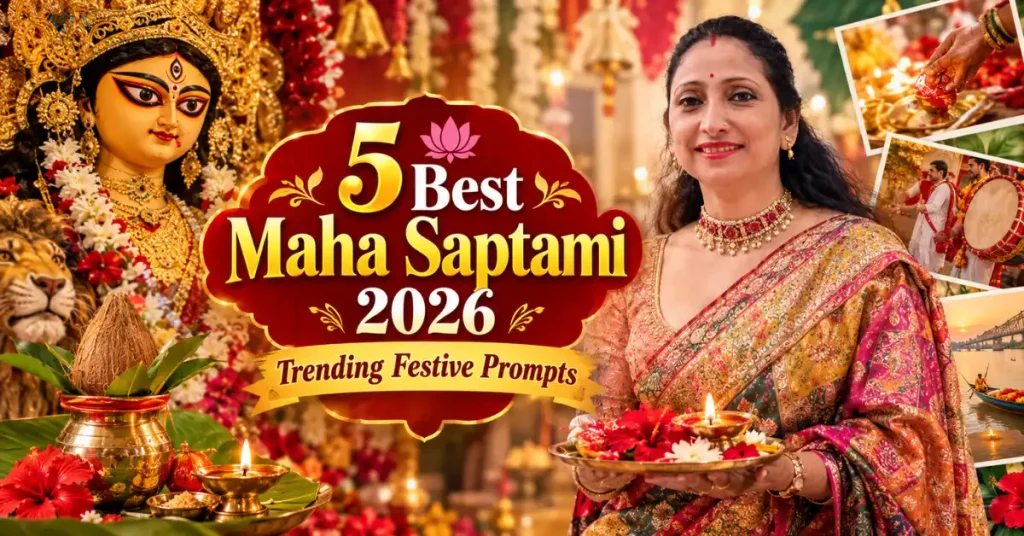

Explore professional-looking photography ideas with these Maha Saptami 2026 trending festive prompts.
This page brings together traditional Maha Saptami photo ideas that you can use to create realistic AI images.
Best part is result looks like a DSLR photography. The prompts are designed to maintain the recognizable facial characteristics.
Your reference image get a new shapes with with traditional Bengali and Indian festive elements.
You do not need to spend a lot of time thinking about how to write an AI image prompt.
This article brings together ready-to-use Maha Saptami AI photo prompts.
Since Saptami Puja is part of Navaratri, some image prompts feature both traditional Saptami Puja outfits and vibrant Navaratri attire.
You can enjoy luxurious fashion styles with stunning 8K cinematic DSLR quality for eye-catching, viral-worthy images.
Lets dive into the real world of Best AI Photo Prompts To Create Stunning Festive Photos
Maha Saptami Puja 2026 Stunning Festive Photo Prompts
The prompts focus on natural looks, skin texture, and realistic facial details. Apar from that you can edit or update the traditional clothing, or Durga Puja surroundings.

Also read
Hanuman Prompt Generator : Best 8K AI Image Prompts (opens in a new tab)
In today's article, we are going to explore Hanuman prompt generator images, Hanuman prompt generator videos, and Hanuman Ji prompts…
You will find different styles of prompts here. Some prompts may give you a traditional red-and-white saree looks.
On the other hand— few prompts are focus on pandal photography,or devotional portraits, and cinematic festive scenes.
This Maha Saptami 2026 Trending Festive Prompts are tested multiple times before listing to this page.
Let’s dive into the world of Maha Saptami 2026 social media photo prompts and explore the fresh Durga Puja look.
Navratri Red Outfit ChatGPT Image Prompt
Are you looking for ideas to create realistic images that capture the festive feeling of Maha Saptami 2026?
In this article, you will find Durga Puja AI photo ideas or prompts that are easy to copy and use.
You can also customize the prompts according to your needs.
Our first prompt shows large central portrait with multiple smaller portraits of the same woman in different outfits.
Cinematic Multi-Panel Portrait Collage Photo Prompt

Create an ultra-realistic, premium-quality 8K cinematic DSLR Durga Puja festive poster inspired by the attached reference image’s sophisticated multi-panel portrait collage, dramatic radial composition, elegant golden lighting, and luxury editorial art direction. The final artwork must look like a professionally photographed Bollywood festive campaign blended with a high-end Bengali Durga Puja fashion editorial, with photorealistic skin texture, realistic silk fabrics, graceful feminine elegance, atmospheric depth, rich festive colors, and beautifully integrated Bengali typography. Use a vertical 4:5 poster composition with a visually dominant central portrait and multiple surrounding portraits of the exact same woman, each displaying a different Durga Puja outfit, pose, and expression. **CENTRAL HERO PORTRAIT — ELEGANT PRANAM MUDRA:** Place a beautiful adult Bengali woman at the exact center of the composition, standing gracefully in a peaceful devotional Pranam Mudra, with both palms naturally joined at chest level, fingers pointing upward, wrists aligned, shoulders relaxed, and a gentle, heartfelt smile. Her expression should convey devotion, happiness, confidence, and the festive spirit of Durga Puja. Give her a luxurious peach-pink blended saree with a luminous champagne-gold finish, featuring a sophisticated gradient from soft peach and dusty rose to warm blush pink, with delicate gold zari embroidery, fine woven motifs, an elegant gold-bordered pallu, and a rich, glossy silk texture. The saree should reflect the warm cinematic light naturally, with realistic folds, graceful draping, and subtle metallic highlights. Style her with premium traditional gold jhumka earrings, an elegant gold necklace, bangles, a delicate ring, a small red bindi, and a modern, sophisticated smartwatch clearly visible on one wrist. Her hairstyle should be an elegant, professionally styled Bengali-inspired look: voluminous, glossy dark hair with soft defined curls, a graceful side part, carefully arranged face-framing strands, and a polished silhouette. Keep her face unobstructed and beautifully illuminated. Maintain realistic body proportions, anatomically accurate joined hands, detailed jewelry, and natural skin texture. **IDENTICAL WOMAN — SURROUNDING DURGA PUJA FASHION PORTRAITS:** Recreate the same woman in seven distinct surrounding portrait panels arranged in a dramatic radial, fan-shaped collage around the central hero. Every surrounding portrait must clearly depict the same individual, preserving her facial identity, eye shape, nose, lips, complexion, hairstyle characteristics, and recognizable features. Only the outfit, hairstyle arrangement, pose, expression, accessories, and photographic treatment may vary. Each portrait should have its own elegant pose and styling, with carefully controlled lighting and seamless panel transitions. The first surrounding portrait features her in a luxurious red salwar kameez with delicate gold embroidery, a flowing dupatta, traditional earrings, and a confident festive expression. The second portrait presents her in a radiant yellow silk saree with an antique-gold border, graceful pleats, gold jewelry, and a joyful, sunlit expression. The third portrait showcases a classic Bengali white saree with a bold red border, traditional red-and-white bangles, a prominent red bindi, elegant Bengali-style hair, and authentic festive styling inspired by Sindoor Khela and Bijoya Dashami. The fourth portrait features a beautiful pink saree in glossy silk with delicate gold detailing, refined jewelry, soft curls, and a charming, celebratory pose. The fifth portrait presents her in a contemporary cyan-blue kurta with sophisticated embroidery, subtle earrings, a modern hairstyle, and a fresh, graceful appearance. The sixth portrait showcases a luxurious yellow-and-black silky ghagra ensemble with flowing layered fabric, intricate gold embellishments, a fitted festive blouse, and elegant traditional jewelry. The seventh portrait features her in a regal orange Anarkali dress with elaborate gold embroidery, a flowing dupatta, statement earrings, and a sophisticated festive hairstyle. Arrange these seven portraits in distinct angular sections surrounding the central figure, following the reference image’s elegant triangular and diagonal panel structure. Include a balanced combination of close-up portraits, three-quarter fashion poses, and medium-length compositions. Allow selected panels to appear subtly monochromatic or softly desaturated while keeping the principal portraits in rich color, but ensure that the overall design remains warm, luxurious, cohesive, and visually balanced. Separate the panels with thin champagne-gold illuminated borders, soft feathered transitions, and carefully controlled shadows. The central woman must remain the largest, sharpest, and most prominent subject. **FLOATING SILK FABRIC — SIGNATURE CINEMATIC MOTION:** Introduce luxurious flowing fabric ribbons in crimson red, deep burgundy, ruby, scarlet, and subtle rose-pink tones, inspired by premium Bollywood theatrical posters. The fabric should sweep gracefully around the outer edges of the collage and weave between selected portrait panels, creating the impression of elegant silk suspended in motion. Use believable wind-driven curves, sculptural folds, realistic textile thickness, delicate specular highlights, and soft directional motion. Some ribbons should pass behind the central woman and surrounding portrait panels, while carefully selected foreground sections create a sense of three-dimensional depth. The flowing fabric must frame the woman rather than obscure her face, joined hands, saree details, smartwatch, or jewelry. Integrate small sections of peach-pink and champagne-gold translucent silk to harmonize with the central saree. Keep the fabric sophisticated, fluid, and photographic rather than plastic-looking or excessively theatrical. **MODERN ABIR DUST — FESTIVE LOWER ATMOSPHERE:** Concentrate a beautiful cloud of realistic Abir powder around the lower third and bottom edges of the poster. Blend crimson red, vermilion, magenta, rose pink, and subtle golden pigment particles into softly illuminated clouds that rise naturally around the lower portrait panels. Add delicate airborne powder, tiny floating particles, fine pigment trails, and gentle volumetric backlighting. The Abir should interact naturally with the moving silk ribbons and warm atmospheric haze, creating a celebratory Bengali festive mood without resembling artificial smoke or paint splashes. Preserve clean negative space behind the Bengali text so every character remains crisp and legible. Keep the central woman’s face, hands, saree, and important accessories completely free of obstructive powder. **BACKGROUND AND CINEMATIC LIGHTING:** Create a luxurious, atmospheric background featuring warm golden-hour illumination, subtle temple-pandal-inspired bokeh, softly glowing festive lights, delicate golden dust, and a rich blend of champagne gold, warm ivory, deep burgundy, muted rose, and dark cinematic brown. Add subtle rays of light behind the central portrait to create a natural halo-like separation without introducing excessive religious symbols or overwhelming decorative elements. Use professional full-frame DSLR aesthetics, an 85mm portrait-lens look, a wide aperture around f/1.8, realistic shallow depth of field, precise facial focus, beautiful optical bokeh, soft rim lighting, and natural skin highlights. Apply premium color grading with warm highlights, controlled shadows, realistic skin tones, and refined contrast. The central portrait should be exceptionally sharp, while the surrounding portraits remain detailed and the far background falls into elegant cinematic softness. **BENGALI TYPOGRAPHY — EXACT TEXT AND PLACEMENT:** Reserve the bottom portion of the composition for three lines of Bengali typography. Place the headline in the lower-middle title area, immediately below the central woman and above the densest Abir particles. Render the exact first line: “শুভ দুর্গাপূজা!” Use a large, bold, premium Bengali display font with beautifully shaped Devanagari-influenced Bengali letterforms appropriate to the Bengali script, refined curves, confident strokes, and luxurious champagne-gold and warm-ivory coloring. The headline must be the most prominent text element, with subtle metallic embossing, realistic dimensional highlights, a restrained shadow, and an elegant warm glow. Ensure the spelling and Bengali characters are correct. Directly beneath the headline, add the following exact two lines in a smaller but highly legible modern Bengali font with graceful letterforms, balanced spacing, and a sophisticated festive editorial finish: “মা দুর্গা আপনার জীবনকে আনন্দ” “শক্তি ও শান্তিতে ভরিয়ে তুলুন।” Render both lines in warm ivory or pale champagne gold, with precise alignment, clean kerning, comfortable line spacing, and enough contrast against the dark burgundy background. Keep the punctuation and wording exactly as supplied. Do not translate, rewrite, abbreviate, or add any extra wording. Use authentic Bengali script rather than Hindi, Assamese, or Latin characters. The three lines must be spelled correctly and remain fully readable at mobile-screen size. Decorate the typography sparingly with fine golden ornamental dividers, delicate lotus stems, tiny lotus blossoms, and elegant curved botanical flourishes. Allow the botanical elements to frame the headline and supporting message without intersecting or obscuring any letter. Keep the title region sophisticated and uncluttered, with enough dark negative space for excellent readability. **FINAL COMPOSITION AND QUALITY CONTROL:** Maintain the central woman in peach-pink and gold as the unmistakable hero, surrounded by seven coordinated portraits of the same woman in the specified Durga Puja outfits. Preserve the reference image’s radial multi-panel arrangement, while adding cinematic floating silk, realistic Abir powder, luxurious Bengali festive fashion, and premium devotional-poster styling. The result should communicate the joy, elegance, cultural richness, devotion, and celebratory warmth of Durga Puja. Render in exceptionally detailed 8K photorealistic quality, with professional fashion photography, anatomically accurate hands, realistic silk textures, intricate jewelry, consistent facial identity across all eight appearances, natural hair detail, elegant panel geometry, refined golden lighting, sophisticated color grading, and flawless Bengali typography. STRICT NEGATIVE CONSTRAINTS: No different identities across panels, no inconsistent facial features, no distorted hands, no extra fingers, no duplicated limbs, no unnatural Pranam Mudra, no poorly draped sarees, no cheap-looking fabric, no plastic-like silk, no cartoon effects, no excessive glow, no oversaturated skin, no cluttered panels, no random text, no misspelled Bengali words, no broken Bengali characters, no unwanted English text, no watermark, no logo, and no text obscured by fabric, flowers, or Abir. FINAL OBJECTIVE: Create a breathtaking, luxury Bengali Durga Puja poster featuring one consistent woman in eight distinct appearances, a central peach-pink and gold saree portrait in Pranam Mudra, seven surrounding festive fashion portraits, flowing crimson silk ribbons, realistic red-and-pink Abir dust, cinematic golden illumination, and the exact Bengali greeting “শুভ দুর্গাপূজা!” followed by “মা দুর্গা আপনার জীবনকে আনন্দ” and “শক্তি ও শান্তিতে ভরিয়ে তুলুন।” The finished artwork must feel like a premium Bollywood festive campaign and a professionally art-directed Durga Puja fashion poster.For example you can edit the dress, hairstyle, location, or pose.
These Maha Saptami 2026 Trending Festive Prompts are especially useful,
if you want to give an old photograph a new festive look without spending hours editing it.
This festive season, your professional photo edits are just one click away from transforming your ordinary images into extraordinary ones.
Durga Devi Background Image Prompt for Girl
The prompts are created around photorealistic images, cinematic portraits, traditional Bengali styling, and realistic DSLR-inspired photography.
During Saptami Puja, pandals are decorated, Durga idols are beautifully arranged.
The festive atmosphere becomes an important part of the celebration.
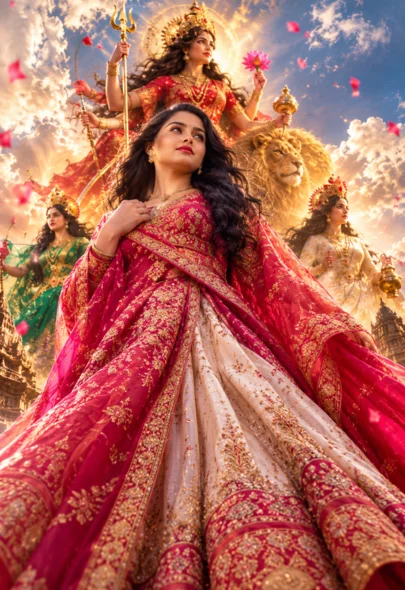
Act as a senior Bollywood film-poster designer and luxury cinematic art director with 12+ years of experience creating award-winning theatrical posters, photorealistic devotional compositions, and premium cinematic artwork.
REFERENCE IMAGE INSTRUCTIONS:
Use Image 1 as the primary reference for the central subject’s facial identity, facial proportions, hairstyle, and overall appearance. Use Image 2 as the reference for the divine background, Goddess Durga, her multiple manifestations, lions, traditional temple architecture, devotional atmosphere, and celestial color palette. Preserve the recognizable features of the central subject from Image 1 while blending the divine elements of Image 2 naturally into the composition.
CAMERA ANGLE AND FACIAL PROXIMITY:
Create an exceptionally dramatic, extreme worm’s-eye-view portrait, as if the camera is positioned very low near the ground and tilted upward toward the subject. However, the central subject must look directly into the camera lens, with the face oriented toward the viewer rather than turned sideways or looking into the sky.
Make the central subject’s face significantly larger, closer, and more prominent than in the previous composition. Position the face in the upper-central portion of the frame, with direct eye contact, naturally aligned eyes, a clearly visible forehead, and a sharply focused facial expression. The face must feel visually close to the camera, creating a powerful sense of presence and connection with the viewer.
Use a wide cinematic perspective with carefully controlled perspective distortion. The subject’s upper body and clothing should extend dramatically toward the bottom foreground, emphasizing the low-angle viewpoint without distorting the face, eyes, or facial proportions. Maintain realistic anatomy and natural facial geometry.
CENTRAL SUBJECT’S CLOTHING:
Dress the central subject in a luxurious, bright-red silk kurta with a premium, silky-smooth, glossy finish. The fabric must feature elegant, fine golden stripes running vertically from the shoulders down the visible length of the kurta. Make the gold stripes precise, evenly spaced, sophisticated, and beautifully integrated into the rich red fabric.
The kurta should display realistic silk reflections, natural fabric folds, fine stitching, and subtle golden highlights under cinematic lighting. The overall appearance must be traditional, devotional, elegant, and luxurious rather than flashy. Preserve the rich red-and-gold color harmony throughout the garment.
POSE AND HAND POSITION:
Position the subject’s hands together in a respectful Namaste or Pranam Mudra at chest level, with both palms joined naturally, fingers pointing upward, and wrists aligned comfortably. Ensure anatomically accurate hands, realistic finger placement, natural finger lengths, and a peaceful, reverent posture.
Keep the joined hands clearly visible in the lower-middle foreground without covering the face or obstructing the direct eye contact. The subject should have relaxed shoulders and a dignified, devotional presence.
FOREHEAD TIKA:
Add a clearly visible traditional red tika on the center of the forehead, positioned naturally between the eyebrows and above them. The tika should look authentic, clean, and culturally appropriate, complementing the subject’s devotional appearance. Keep the tika sharply defined and naturally integrated into the skin.
DIVINE BACKGROUND — BASED ON IMAGE 2:
Behind the central subject, create a majestic devotional scene featuring Goddess Durga in her divine multi-armed form, wearing an ornate golden crown and richly embroidered red garments. Include her powerful lion, traditional divine attributes such as a trident and lotus, and additional goddess manifestations in complementary red, magenta, green, and ivory attire.
Arrange the goddess figures at different depths behind the central subject, creating a grand, layered cinematic composition. Place Goddess Durga prominently above and behind the central subject, with her divine presence clearly recognizable without competing with the central subject’s face.
Include magnificent ancient Indian temple architecture, distant temple spires, luminous golden clouds, a radiant sunset sky, gently floating red flower petals, and subtle golden particles. Blend all background elements into one coherent environment rather than separate cutout images.
LIGHTING AND COLOR GRADING:
Use premium cinematic lighting with soft, natural illumination on the central subject’s face, realistic catchlights in both eyes, gentle highlights on the forehead, and balanced shadows around the cheeks and jawline. Add a warm golden rim light around the hair and shoulders, complemented by subtle crimson reflections from the silk kurta.
Use a rich devotional palette of ruby red, deep magenta, antique gold, warm ivory, and celestial blue. Preserve natural skin texture, realistic pores, fine facial details, and lifelike hair strands. Avoid excessive smoothing, artificial skin, oversaturated colors, or harsh HDR effects.
IMAGE QUALITY AND FINAL COMPOSITION:
Create a crystal-clear, ultra-photorealistic image with precise facial details, realistic silk texture, accurate hands, physically believable lighting, and exceptional depth. The central subject’s eyes and face must be the primary focal point, with the clothing and divine background supporting the composition.
Vertical 2:3 poster composition, premium theatrical film-poster quality, realistic photographic depth, high-resolution details, professional full-frame camera aesthetics, controlled wide-angle perspective, natural skin tones, and refined cinematic color grading.
STRICT NEGATIVE INSTRUCTIONS:
Do not turn the central subject’s face away from the camera. Do not make the subject look upward toward the goddess. Do not use a distant face, tiny face, side profile, or three-quarter profile. Avoid distorted facial proportions, asymmetrical eyes, crossed eyes, blurry facial details, deformed hands, extra fingers, fused fingers, duplicated limbs, inaccurate Namaste gestures, incorrect tika placement, plastic skin, cartoon styling, excessive glow, artificial-looking fabric, random text, watermarks, logos, or unwanted lettering.
FINAL PRIORITY:
The central subject must have a large, sharply focused face looking directly into the camera lens, a luxurious red silk kurta with fine vertical gold stripes, joined Namaste hands, and a clearly visible red forehead tika. Maintain the majestic Goddess Durga devotional background from Image 2 while ensuring the central subject remains the dominant foreground presence.So why not bring that atmosphere into your WhatsApp status, Instagram post, or personal photo collection?
AI image generation can help you experiment with different festive backgrounds, along with clothing styles, and compositions.
However, the final result can vary depending on the AI image-generation tool. You can use ChatGPT for best realistic 8K portraits.
How to Create Maha Saptami 2026 Trending Festive Images?
Creating a festive AI photograph is quite simple if your image-generation tool can clone the reference images.
You can follow these steps to create your own Maha Saptami image.
- Step 1: Open ChatGPT or another AI image-generation tool in your web browser.
- Step 2: Sign in to your account.
- Step 3: Return to this article and choose the Maha Saptami prompt you like.
- Step 4: Copy the complete prompt.
- Step 5: Paste the prompt into the AI image-generation interface.
- Step 6: Upload your photograph as a reference image if the tool supports image references.
- Step 7: Generate the image and check the result.
If the first result does not look exactly as you expected,then you can modify the prompt. For example, you can change the saree color or, background details or the camera angle.
Also read
Do you want realistic DSLR photo prompts or realistic Durga Puja photoshoot prompts this Durga Puja? If yes, you can…
Even you can set the pose, or festive decorations as per your choice.
Cinematic Navrti Image Prompt
For better results, use a clear reference photograph where the face is visible and not heavily covered by sunglasses, shadows, filters, or other objects.
Keep in mind that AI-generated images can change some facial details, clothing elements, hands, jewellery, or background objects,
so it is always worth checking the final image before sharing it.
Creative Maha Saptami photo ideas are shared on this page so that you can transform an ordinary photograph into a festive Durga Puja portrait.
Maha Saptami is observed on the Saptami tithi during Durga Puja, and it is an important day of the festival in Hindus. Most of the devotees participate in worship and celebrations dedicated to Maa Durga.
Also read
5+ Best Love Couple AI Photo Prompts for Matching Dresses (opens in a new tab)
Are you looking for unique and Best Love Couple AI Photo Prompts for Matching Dresses? Today, we will see how…
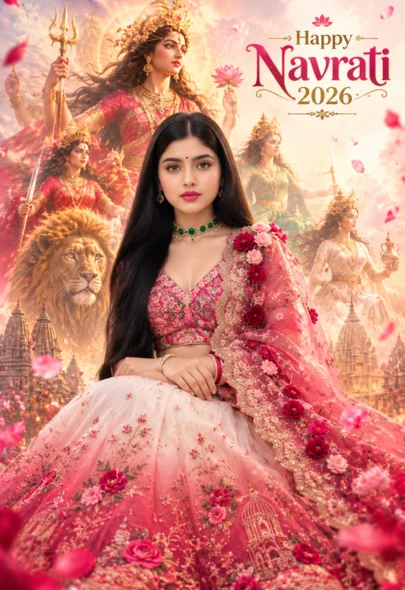
Act as a senior Bollywood film-poster designer and luxury cinematic art director with 12+ years of experience creating award-winning theatrical posters, high-end Indian fashion editorials, devotional artwork, and sophisticated double-exposure compositions. Create a breathtaking, ultra-realistic vertical Navratri 2026 celebration poster featuring an elegant young Indian woman in the center foreground, surrounded by a magnificent divine composition of Goddess Durga, her lion, additional goddess manifestations, ancient Indian temples, and a radiant celestial sky. CENTRAL FEMALE SUBJECT: Place a beautiful young Indian woman (100% same facial features from this image) prominently in the center of the composition, facing the camera with direct eye contact and a serene, confident, devotional expression. She has long, silky, jet-black hair flowing naturally over her shoulders, expressive brown eyes, realistic skin texture, elegant facial features, and subtle traditional makeup. Add a small, tasteful red bindi, delicate gold earrings, and a luxurious emerald-green beaded choker necklace with gold detailing. Her face must be sharply focused, naturally proportioned, and clearly recognizable. Use soft, flattering illumination with realistic catchlights in the eyes and subtle golden highlights along her hair. Avoid artificial skin smoothing or exaggerated facial features. LUXURIOUS INDO-WESTERN LEHENGA: Dress the woman in an exceptionally ornate contemporary Indo-Western lehenga with a fitted, deep-rose-pink choli featuring a flattering V-neckline and short sleeves. The blouse is richly embroidered with intricate floral motifs in dark pink, rose, muted green, and antique gold threadwork, enhanced with delicate sequins and fine zari embroidery. The voluminous lehenga skirt begins in crisp ivory-white near the waist and gradually transitions into luminous blush pink, rich rose pink, and deep raspberry pink toward the hem. The ombré transition must appear smooth, gradual, and beautifully blended. Use lightweight translucent net or organza layers over a premium fabric base. Decorate the skirt with detailed embroidered roses, scattered miniature flowers, elegant botanical vines, and delicate traditional architectural motifs resembling miniature temple domes and ornamental pavilions. The lower skirt features a wide, densely embroidered scalloped border with intricate gold threadwork and luxurious floral patterns. DRAMATIC DUPATTA AND FLORAL EMBELLISHMENTS: Drape a rich rose-pink dupatta elegantly over the woman’s left shoulder in a graceful traditional pallu-inspired arrangement. Its broad scalloped border should feature exceptionally fine floral vines, antique-gold embroidery, sparkling sequins, and subtle stonework. Add realistic three-dimensional fabric roses in blush pink, hot pink, and deep crimson cascading from the shoulder down along the dupatta and arm. The floral appliqués should have visible layered petals, realistic shadows, and natural depth. Ensure the embroidery, fabric transparency, and flower placement look physically believable rather than digitally pasted. THE DIVINE DOUBLE-EXPOSURE BACKGROUND: Behind the central woman, create a magnificent, large-scale double-exposure composition featuring Goddess Durga in her divine multi-armed form. Her face, ornate golden crown, traditional red attire, jewelry, trident, and lotus should be clearly recognizable within the luminous background. Position the largest manifestation of Goddess Durga in the upper-left background, with a radiant golden halo surrounding her crown and head. Include her majestic lion in the middle-left background, with detailed golden-brown fur, expressive eyes, and realistic anatomy. Blend additional goddess manifestations into the surrounding atmosphere: one in rich magenta, another in emerald green, and another in elegant ivory and gold. Give each figure traditional attire, ornate crowns, divine attributes, and a graceful devotional presence. The goddess figures should appear as monumental, semi-transparent cinematic layers integrated into luminous clouds, golden mist, and atmospheric light. The effect must resemble sophisticated photographic double exposure, not a collection of disconnected cutout images. ANCIENT TEMPLES AND CELESTIAL ENVIRONMENT: Create an expansive ancient Indian temple landscape behind the figures, featuring intricately carved temple spires, traditional stone architecture, distant shrines, and soft atmospheric depth. The sky should glow with warm ivory, peach, pale gold, and delicate blush-pink clouds. Golden sunlight streams through the clouds behind Goddess Durga, creating a divine aura and beautiful volumetric light rays. Add softly floating rose petals throughout the scene, with a few large, softly blurred petals near the foreground edges to create cinematic depth. Include delicate golden particles and subtle floral bokeh without obscuring the central woman’s face. COMPOSITION AND DEPTH: Use a vertical 2:3 theatrical-poster composition. The woman occupies the central foreground, with her face positioned around the upper-middle region and her elaborate lehenga filling the lower portion of the image. Goddess Durga should rise majestically behind her, primarily in the upper-left region, while the additional goddess figures, lion, and temple architecture create depth along the left and right sides. Maintain a clear visual hierarchy: the woman is the primary foreground subject, Goddess Durga is the dominant divine background presence, and the temples, petals, and atmospheric effects support the overall composition. Use realistic photographic depth of field, carefully layered foreground and background elements, natural perspective, and seamless double-exposure blending. LIGHTING AND CINEMATIC COLOR GRADING: Use premium golden-hour cinematic lighting, soft frontal illumination on the woman’s face, delicate highlights on the emerald necklace, and warm rim lighting around her black hair. Illuminate the divine background with radiant golden sunlight and soft volumetric rays. The lehenga should display realistic fabric reflections, intricate embroidery, fine stitching, and natural folds. Use a sophisticated palette of ivory white, blush pink, rose pink, deep raspberry, antique gold, emerald green, and warm celestial peach. Maintain luminous highlights, rich yet controlled contrast, realistic shadows, and natural skin tones. TYPOGRAPHY — “Happy Navrati 2026”: At the top-right of the poster, add the exact text: Happy Navrati 2026 Use a premium, modern editorial serif typeface with elegant high-contrast letterforms. Make “Navrati” the largest word, “Happy” smaller above it, and “2026” centered underneath. Use deep raspberry-pink and antique-gold lettering, with a subtle dimensional finish, refined soft shadow, and delicate ornamental gold flourishes on either side. Add a small stylized pink lotus motif above the heading and tasteful decorative separators beneath the year. Keep all typography clear, accurately spelled, beautifully aligned, and completely within the frame. Position the lettering against a softly illuminated, relatively uncluttered area of the sky so that it remains highly readable without covering the central woman or Goddess Durga. FINAL IMAGE QUALITY: Ultra-photorealistic luxury Indian fashion photography, premium Bollywood devotional-poster aesthetics, crystal-clear facial details, lifelike hair, highly detailed embroidery, realistic three-dimensional floral appliqués, intricate temple architecture, majestic divine imagery, seamless double exposure, sophisticated cinematic lighting, natural skin texture, atmospheric depth, and exceptionally refined color grading. Vertical 2:3 aspect ratio, high-resolution output, professional full-frame camera aesthetics, exceptional visual clarity, and a polished commercial-poster finish. STRICT NEGATIVE INSTRUCTIONS: No man, no male model, no extra foreground people, no distorted faces, no asymmetrical eyes, no malformed hands, no duplicated limbs, no artificial plastic skin, no cartoon rendering, no flat illustration, no excessive glow, no oversaturated colors, no messy typography, no misspelled text, no extra words, no watermarks, no logos, and no borders. The final result must look like a luxurious, professionally art-directed Navratri 2026 festival poster combining elegant Indian fashion, divine Goddess Durga imagery, sophisticated double exposure, and premium cinematic realism.Bengali festive photography is not limited to clothing or in a red saree.
Navratri Lehenga Choli Image Prompt Fee Download
Since Saptami Puja is part of Navratri, some prompts feature Garba dresses and traditional Navratri attire in stunning 8K cinematic DSLR quality.
The atmosphere of the pandal, traditional decorations, and expressions all contribute to the final look of a photograph.
That is why these prompts focus on more than just a red-and-white saree. You can experiment with traditional Bengali outfits and , jewellery including pandal backgrounds.
Also read
7+ Copy-paste Gemini AI prompts for dslr photography (opens in a new tab)
In today’s article, we are going to talk about 7+ copy-and-paste Gemini AI prompts for DSLR photography. The best part…
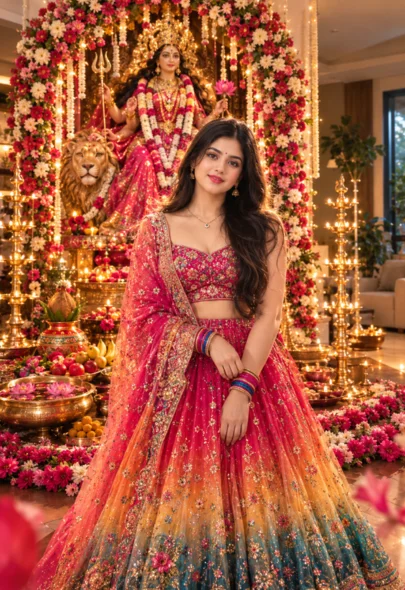
Act as a senior Bollywood fashion photographer and luxury cinematic art director with 12+ years of experience creating photorealistic Indian festive portraits, premium ethnic fashion editorials, and sophisticated devotional compositions. REFERENCE IMAGE INSTRUCTIONS: Use Image 1 as the primary reference for the woman's facial identity, facial proportions, complexion, eyes, nose, lips, and recognizable appearance. Preserve her natural identity and realistic facial details. Use Image 2 as the reference for the multicolored ombré lehenga design, embroidery, fabric texture, and color transitions. Use Image 3 as the reference for the indoor Goddess Durga puja setting, idol, floral arch, lion, lamps, offerings, and warm festive atmosphere. Combine these references into one coherent, photorealistic composition. CENTRAL FEMALE SUBJECT: Create a photorealistic, high-resolution portrait of a beautiful young Indian woman with a fair complexion, looking directly into the camera with a soft, confident smile. Her head is tilted slightly to her right. She has long, voluminous, naturally flowing dark brown hair with subtle caramel highlights, cascading elegantly over her right shoulder. Preserve her facial identity, natural skin texture, realistic pores, expressive eyes, and authentic Indian facial features. Add a small black bindi centered on her forehead. Her makeup features defined winged eyeliner, warm eyeshadow, softly illuminated cheeks, and glossy deep-red lipstick. Her expression is graceful, warm, festive, and confident. LUXURIOUS MULTICOLORED OMBRÉ LEHENGA: Dress the woman in a breathtaking, heavily embellished contemporary Indian lehenga choli featuring a dramatic multicolored vertical ombré gradient. The fitted choli has an elegant sweetheart neckline and delicate shoulder straps. Its upper fabric features deep magenta, hot pink, and vibrant ruby-red tones, richly decorated with intricate golden floral embroidery, fine zari threadwork, sparkling sequins, and delicate crystal embellishments. The voluminous, floor-length lehenga skirt begins with deep magenta, hot pink, and rich red around the waist and gradually transitions through bright orange, warm peach, and luminous golden yellow across the middle, finally fading into cool teal and cerulean blue near the bottom hem. Ensure the color transitions are smooth, seamless, and artistically blended, with each color remaining vivid and distinguishable. Cover the skirt with dense, intricate floral embroidery featuring gold and yellow blossoms, pink and red floral accents, delicate leaves, and elegant ornamental patterns. Incorporate realistic sequin reflections, subtle mirror-work details, fine crystal highlights, and luxurious golden threadwork. The skirt should have a dramatic traditional flare, with multiple layers of lightweight net or organza over an opaque lining. Add a thick, richly embroidered antique-gold zari border around the bottom hem. The finished outfit must appear like premium designer couture, with realistic fabric weight, natural folds, finely detailed stitching, and beautiful light-catching embellishments. DUPATTA AND ACCESSORIES: Add a sheer, lightweight dupatta draped gracefully over her right shoulder, falling naturally alongside the lehenga. Its transparent fabric should complement the multicolored gradient and feature delicate gold floral embroidery, sparkling sequins, and a fine ornamental border. Accessorize her with elegant traditional gold earrings, a delicate gold necklace, and colorful stacks of pink, blue, and gold bangles on both wrists. The jewelry should look realistic and tasteful, complementing the elaborate outfit without overpowering it. Keep her long dark hair flowing naturally, with individual strands visible and subtle highlights reflecting the warm ambient light. POSE AND COMPOSITION: Position the woman in the center foreground, standing gracefully in front of the Goddess Durga puja arrangement. Her shoulders should be relaxed, her posture natural, and her face turned directly toward the camera. One hand may rest naturally near her waist while the other gently holds the dupatta or rests beside the lehenga, allowing the intricate outfit to remain clearly visible. Keep both hands anatomically accurate with natural finger placement. Frame the composition to showcase her face, jewelry, embroidered blouse, and the colorful gradient of the lehenga. Use a three-quarter or nearly full-length portrait so the skirt's full color transition and decorative hem can be appreciated. GODDESS DURGA BACKGROUND — INDOOR PUJA DECORATION: Create an elegant, richly decorated indoor Hindu puja setting inspired by a traditional Navratri or Durga Puja celebration in a modern Indian home. Position a beautifully decorated Goddess Durga idol in the center background, wearing a vibrant pink-and-gold traditional outfit, an elaborate golden crown, and layered garlands of white and pink flowers. Her divine face should be serene and detailed, with traditional ornaments and a majestic devotional presence. Show Goddess Durga seated on her magnificent lion, whose golden-brown mane, expressive face, and front paws are partially visible beside the idol. Include a traditional trident and other appropriate devotional elements. Surround the idol with a magnificent semicircular floral arch, or prabhavali, decorated with fresh pink, white, and red roses, carnations, hanging flower strings, and warm golden fairy lights. The floral arch should frame the idol naturally and create a beautiful, symmetrical festive arrangement. PUJA OFFERINGS AND FOREGROUND DETAILS: At the base of the idol, create an elaborate traditional puja arrangement with realistic ritual objects and carefully organized offerings. Place a large, shallow brass urli filled with clear water and floating pink lotus flowers in the foreground. Include a decorated brass kalash with a coconut and mango leaves positioned slightly to the right. Arrange brass bowls containing fresh bananas, apples, pears, laddoos, and other traditional prasad offerings. Add tall, multi-tiered brass diya stands on the left and right sides, with small oil flames producing a warm, natural glow. Create a thick semicircular carpet of fresh pink and white flower petals around the puja platform. Every brass vessel, flower, diya, and offering should have realistic material texture and believable proportions. MODERN INDIAN HOME ENVIRONMENT: Set the puja arrangement inside a sophisticated contemporary Indian living room. Include a softly blurred beige sofa, a warm-toned wooden cabinet, tasteful indoor plants, and a large window in the distant background. The home interior should remain subtle and atmospheric, providing context without distracting from the central woman or the Goddess Durga idol. The floral arch and deity should be the most prominent background elements. LIGHTING AND COLOR GRADING: Use warm, realistic illumination from the diyas and fairy lights, complemented by soft professional portrait lighting on the woman's face. Create gentle golden highlights along her hair, natural catchlights in her eyes, realistic reflections on her jewelry, and subtle illumination across the colorful embroidery. Preserve natural skin tones without overexposure. The dominant palette should include vibrant magenta, ruby red, orange, golden yellow, teal blue, antique gold, floral pink, ivory white, and warm brown. Use professional full-frame camera aesthetics, an 85mm portrait lens, shallow depth of field, creamy background bokeh, realistic optical falloff, and sharp focus on the woman's eyes and face. Keep the lehenga embroidery crisp and detailed while allowing the distant home interior to remain softly blurred. FINAL IMAGE QUALITY: Ultra-photorealistic Indian festive fashion photography, crystal-clear facial details, natural skin texture, realistic hair strands, intricate zari embroidery, shimmering sequins, finely rendered organza, accurate jewelry, authentic puja decorations, realistic brass reflections, lifelike flower petals, and physically believable warm lighting. Vertical 2:3 composition, high-resolution commercial photography, premium Indian ethnic fashion editorial, elegant festive atmosphere, realistic depth, refined cinematic color grading, and exceptional visual clarity. STRICT NEGATIVE INSTRUCTIONS: Do not alter the woman's facial identity. No different face, no excessive skin smoothing, no artificial plastic skin, no distorted eyes, no asymmetrical facial features, no malformed hands, no extra fingers, no duplicated limbs, no distorted jewelry, no muddy or discontinuous ombré colors, no flat fabric, no cartoon styling, no excessive glow, no oversaturated HDR, no messy background, no random text, no watermarks, and no logos. FINAL PRIORITY: The woman must remain the dominant foreground subject with her recognizable face, long dark-brown hair, elegant makeup, and spectacular multicolored ombré lehenga. The Goddess Durga idol, floral arch, lion, brass lamps, and puja offerings must form a beautifully integrated, warm, realistic indoor devotional background.This above prompt need a image of a girl or woman and an image of a durga pandal or statue.
No need any photo filter, a warm evening lights, or devotional settings, and cinematic portrait compositions are already set in these prompts.
You can also customize the prompts according to your own preferences. Change the dress, lipstick colour, jewellery, hairstyle, background, pose, or lighting to create a different version of the same concept.
Also read
This blogs revelead the Best Gemini AI Photo Editing Prompts for Realistic Bengali Portraits that you must try. The Hindu…
These prompts are designed around the elements that are commonly important in a festive portrait:
the subject’s appearance, clothing, environment, lighting, camera perspective, composition, and overall mood.
When refining an AI image prompt, small details can make a noticeable difference. Describing the lighting, background, clothing, camera perspective, and facial characteristics separately can help create a more controlled result.
The prompts below are therefore not intended to be simple keyword lists.
Each one is designed around a particular Maha Saptami photography concept so that you can choose a style that matches the type of image you want to create.
Where possible, test the prompt with a clear reference photograph and make small changes if the generated result does not match your expectation.
Tips for Creating Trending Saptami 2026 Festive Prompts
Some prompts are designed for traditional portraits, while others work better for full-body photographs, pandal scenes, or cinematic festival photography.
A good reference photograph can make a big difference to the final result. Try to use a clear, high-quality photograph with good lighting and a visible face.
Trending Maha Saptami Puja Image Prompts Must Need
- Traditional Bengali clothing or any festival dress details
- Saree and jewellery details
- Pandal decorations and Warm festive lighting
- Natural skin texture and jewellery design
- Realistic facial proportions
- Camera perspective and angle
- Background depth and decoration details
- Natural body posture and Cinematic composition
Avoid adding too many unrelated instructions to one prompt. If the image does not look right, change one or two elements at a time and generate the image again.
AI image-generation results are not always identical. Facial details, hands, jewellery, clothing, lighting, and background elements can sometimes change during generation.
The prompts on this page are intended to help create a recognizable and realistic festive portrait, but no prompt can guarantee an identical face or a particular resolution in every AI image-generation tool.
Saptami Puja Trending Bengali Saree Prompt
The final result also depends on the reference image, AI model, available settings, and the instructions used during generation.
These Maha Saptami 2026 photo prompts are created for anyone who wants to give their photographs a traditional Durga Puja and Bengali festive look.
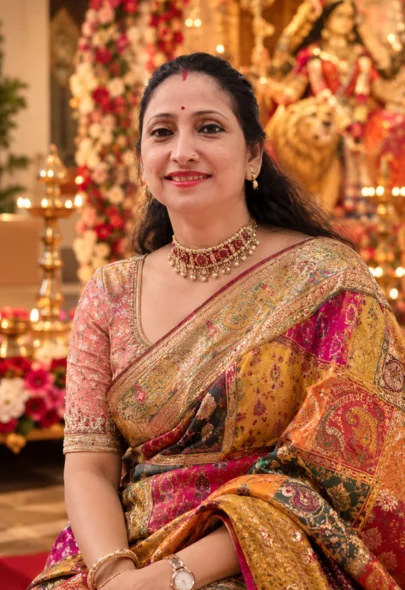
Act as a senior Bollywood film-poster designer, luxury Indian fashion photographer, and expert AI portrait artist specializing in ultra-photorealistic 8K-quality images. FACIAL IDENTITY PRESERVATION — HIGHEST PRIORITY: Use the attached reference photograph as the primary and mandatory facial identity reference for the woman. Preserve her recognizable facial identity as faithfully as possible, including her face shape, forehead, eyebrows, eyes, nose, lips, cheeks, chin, natural complexion, and distinctive facial proportions. Do not replace her face with a generic AI-generated face or reinterpret her identity. The final image must clearly resemble the same woman in the reference photograph. Maintain natural facial geometry, realistic skin texture, fine pores, authentic facial details, and consistent facial proportions. Avoid excessive skin smoothing, artificial beauty filters, exaggerated features, or unnatural facial symmetry. The woman should look directly into the camera lens with a warm, natural smile. Keep both eyes clearly visible, aligned, sharply focused, and illuminated with realistic catchlights. Her face must remain the primary focal point of the image. IMAGE QUALITY AND PHOTOGRAPHIC REALISM: Generate an exceptionally detailed, ultra-photorealistic image with an 8K-quality finish, crystal-clear facial details, realistic skin texture, individual hair strands, finely rendered fabrics, natural lighting, accurate anatomy, and professional full-frame camera aesthetics. Use a professional portrait-photography approach with a high-quality 85mm lens aesthetic, carefully controlled depth of field, realistic highlights and shadows, natural skin tones, and sophisticated cinematic color grading. IDENTITY CONSISTENCY: The attached photograph must determine the woman's facial identity. Other reference images may guide the clothing, pose, background, lighting, and artistic style, but they must not override her facial identity. Keep the face recognizable even when the outfit, hairstyle arrangement, environment, camera angle, or lighting changes. STRICT NEGATIVE INSTRUCTIONS: Do not generate a different face, generic model face, altered facial proportions, different eye shape, changed nose, changed lips, artificial skin, plastic-like texture, excessive retouching, blurry eyes, distorted facial features, asymmetrical eyes, or unrealistic facial geometry. Do not let cinematic effects, dramatic lighting, background elements, or accessories obscure her identity. FINAL PRIORITY: Create a premium, ultra-realistic, high-resolution portrait of the same woman shown in the attached photograph. Facial identity preservation, direct eye contact, natural expression, realistic skin texture, and crystal-clear facial detail are more important than any stylistic enhancement. Aim for an 8K-quality photographic finish while retaining the woman's recognizable natural appearance.You can experiment with red-and-white sarees, traditional jewellery, decorated pandals, devotional surroundings, cinematic lighting, and DSLR-inspired portrait styles.
After Mahalaya, the Durga Puja atmosphere becomes part of the festive season, and Maha Saptami brings another opportunity to capture those traditional moments through photography and AI-generated images.
If you do not have a professional camera or an elaborate photo-editing setup, you can still experiment with these prompts using a suitable AI image-generation tool and your own reference photograph.
FAQs
How to celebrate Chaitra Navratri 2026?
Celebrate by worshipping the nine forms of Goddess Durga, offering prayers, and performing aarti. You can also observe a fast as part of the rituals. Chaitra Navratri 2026 was observed from March 19 to March 27, ending with Ram Navami.
Are Navami and Dussehra on the same day in 2026?
Yes, according to some regional calendars, Maha Navami Puja and Dussehra fall on the same date, October 20, 2026. However, the dates may vary depending on the region and local Panchang in India.
What to offer during Navratri 2026?
You can offer fruits, coconuts, sweets, dairy products, and traditional Satvik food to Goddess Durga. The specific bhog offerings made by Bengali devotees vary according to the day and regional traditions.
What are the trending ChatGPT prompts for photo editing in 2026?
Our prompts feature cinematic portraits, traditional festive looks, Garba night photography, DSLR-style shots, and realistic 4K photo edits.
Conclusion
Try the 5 Maha Saptami 2026 AI photo prompts above and customize them according to your own style.
Let us know in the comment section which Maha Saptami photo idea or prompt you liked the most.
You can create a variety of images with different poses using these prompts.
All these prompts will help you grab more attention on Instagram, Facebook, WhatsApp Status, and other social media platforms.
This Navratri, you can create Ultra HD 8K cinematic-quality images while maintaining your same facial identity.
You no longer need to add photo filters or use paid image-editing apps.
The best part is that you can preserve 100% of your original facial identity, including your eyes, nose, lips, jawline, and natural skin texture.
Write in the comment section which prompt you would like to see next!